
There are hundreds of mortgage marketing ideas a loan officer could try.
Social media. Open houses. Networking. Paid leads. Email. Referral marketing. Sales training. Content. A better website.
The harder question is: what are mortgage professionals actually choosing to invest in?
MLO Studio analyzed resource selections from 353 mortgage professionals who used Morty’s former marketplace. Rather than asking people which marketing strategies they thought sounded useful, we looked at the resources they actually selected.
The clearest finding wasn’t that one marketing tactic won.
It was that loan officers tended to build a marketing stack.
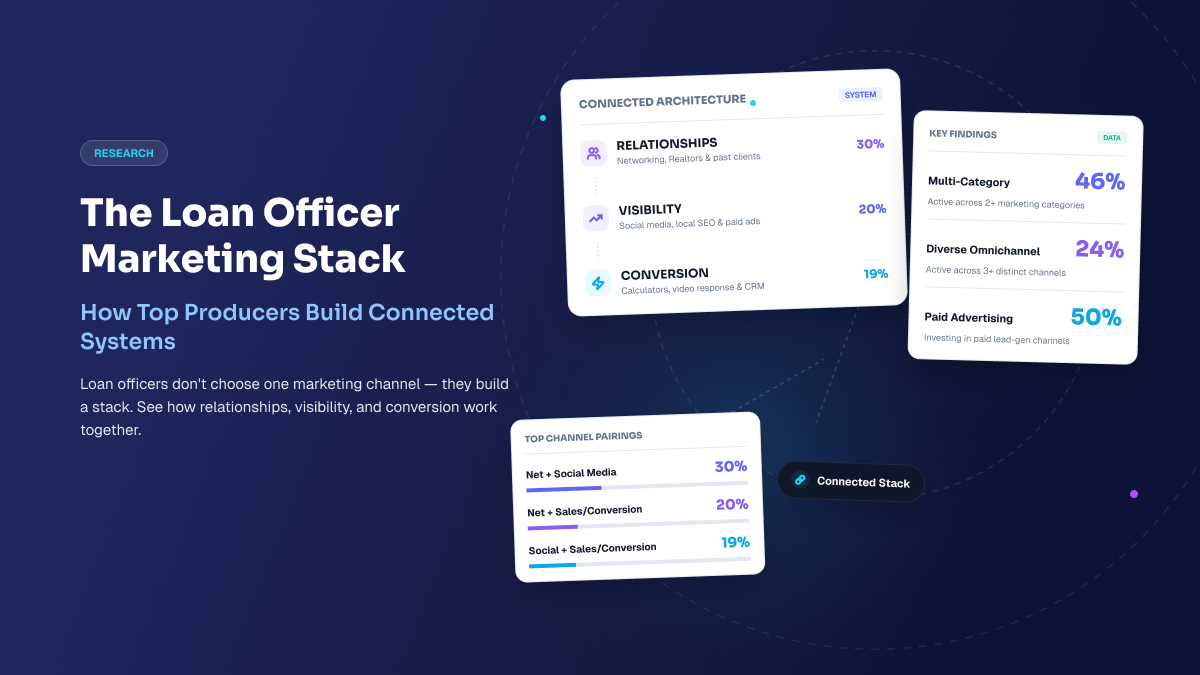
46% selected resources across at least two different marketing categories.
24% selected resources across three or more categories.
And 50% selected at least one paid resource.
The data suggests a practical way to think about mortgage marketing in 2026: don’t search for one magic channel. Build a small set of complementary activities that help you create relationships, stay visible, and convert interest into business.
Here are some of the mortgage marketing ideas that stood out.
1. Build a referral and networking system
The most commonly selected individual resource in the dataset was the Networking Kit, chosen by 41% of mortgage professionals.
That makes relationship-building a natural place to start.
Mortgage is unusually well suited to referral marketing because a loan officer can build relationships with several groups at once: past clients, prospective borrowers, Realtors, financial professionals, builders, attorneys, and members of their local community.
But “network more” isn’t much of a marketing strategy.
A better approach is to turn networking into a repeatable system.
Mortgage networking ideas
Create a short list of people and professional partners you want to stay connected with. Establish a reason to reach out that isn’t simply asking for business. Share useful financing information. Offer resources they can send to their clients. Follow up after meeting someone instead of letting the connection disappear.
For existing borrowers, continue the relationship after closing.
A referral system becomes much more useful when staying in touch is an ongoing part of the business rather than something that happens only when the pipeline gets quiet.
2. Build a consistent social media presence
The Social Media Launch Kit was selected by 40% of mortgage professionals in the dataset—almost identical to the 41% selecting the Networking Kit.
Another social-focused resource, Social Media Marketing 101, was selected by 9%.
That combination is interesting because social media and networking don’t have to be competing strategies.
Social media can help a loan officer stay visible to the network they’re already developing.
A Realtor you met last month can continue seeing your content. A former borrower can be reminded what you do. A prospective client who receives your name from a friend can look you up and see an active professional presence.
Social media ideas for loan officers
You don’t need to turn every post into a mortgage advertisement.
Useful content can include:
- explanations of common mortgage questions
- first-time homebuyer education
- financing terminology
- homebuying process guidance
- market and rate context
- examples of different loan scenarios
- local housing information
- answers to questions borrowers frequently ask
The goal is to create enough useful, consistent visibility that your digital presence supports the relationships you’re building elsewhere.
3. Get better at the first conversation
First Call Training was selected by 33% of mortgage professionals, making it the third-most-selected individual resource in the analysis.
That’s a useful reminder that marketing doesn’t stop when someone becomes a lead.
Getting a referral, generating an online inquiry, or meeting someone at an event only creates an opportunity. The next interaction still matters.
For loan officers, the first conversation can determine whether a prospective borrower understands the process, feels comfortable continuing, and sees the LO as someone who can help.
Improve lead follow-up
Think about the questions a new prospect usually has before you think about the information you want from them.
What happens next? What can they afford? Does talking to a lender affect their credit? How much money will they need? What documents should they prepare?
A good first conversation should make the mortgage process feel more understandable, not more complicated.
This is also where marketing and sales start to overlap. Generating more leads without improving what happens after those leads arrive can leave a large part of the growth system unfinished.
4. Use open houses as more than a one-day event
Open House Flyers were selected by 21% of mortgage professionals.
Open houses are a traditional mortgage marketing tactic, but they can also connect several parts of a modern marketing strategy.
An open house can strengthen a Realtor relationship, introduce a loan officer to prospective buyers, create educational content, generate follow-up opportunities, and give both the Realtor and LO something useful to promote online.
Make an open house work harder
Instead of treating a flyer as the entire strategy, think about the complete experience.
Can buyers easily understand potential financing scenarios?
Is there a useful QR code or landing page?
Can they access a mortgage calculator?
Is there a clear next step if they want to understand affordability or get preapproved?
Can the event become content afterward?
The physical marketing piece can be the beginning of a larger interaction rather than the end of it.
5. Invest in sales and conversion skills
Modern Mortgage Sales was selected by 12% of mortgage professionals in the dataset.
Again, that matters because marketing effectiveness isn’t only about audience generation.
Loan officers can spend significant time developing referral relationships, producing content, building websites, attending events, or generating leads. But eventually someone has to move from interested to engaged.
Marketing and conversion should therefore be designed together.
A strong website should make the next step obvious. Social content should give someone a reason to learn more. Lead follow-up should be timely. Educational content should answer questions that otherwise prevent someone from moving forward.
The objective isn’t simply more attention.
It’s creating a path from attention to conversation.
6. Paid leads can be part of the mix—but not necessarily the whole strategy
The Mortgage Leads Bundle was selected by 11% of mortgage professionals.
More broadly, 50% of the mortgage professionals in the analysis selected at least one paid resource.
Those are two different findings.
The first relates to a specific lead-oriented product. The second shows that half of the analyzed professionals demonstrated some willingness to pay for a marketing or business-development resource.
Paid acquisition can give a loan officer another way to reach prospective clients, but it works best when the rest of the system is ready for the attention.
Before adding more leads, make sure someone who encounters your business can understand who you are, see a credible digital presence, get useful information, and easily take the next step.
From MLO Studio Research
Half of the mortgage professionals analyzed selected at least one paid marketing or business-development resource. But the broader pattern was diversification: 46% selected resources across two or more marketing categories and 24% across three or more.
Explore the full 2026 Loan Officer Marketing Trends Report →
7. Don’t choose between relationships and visibility
One of the more interesting patterns appears when we look at categories together.
30% selected both networking and social-media resources.
20% selected both networking and sales/conversion resources.
19% selected both social-media and sales/conversion resources.
These groups overlap. They aren’t a funnel and shouldn’t be added together.
But they show why thinking about mortgage marketing as a collection of isolated tactics can be limiting.
Networking creates relationships.
Social media and other marketing activity can help you remain visible to those relationships.
Sales and conversion skills can help turn attention into an actual conversation.
Each activity can reinforce the others.
What does a mortgage marketing stack look like?
The category distribution makes the pattern even clearer.
54% selected resources from one marketing category.
22% selected resources from exactly two categories.
24% selected resources from three or more categories.
In other words, 46% crossed into at least two categories.
That doesn’t mean every loan officer needs six marketing channels, ten software tools, and a complicated automation system.
Quite the opposite.
A useful mortgage marketing stack can be fairly simple.
For example:
Relationships: Realtor outreach and past-client referrals.
Visibility: a professional website plus consistent social content.
Conversion: strong first-call follow-up and an easy path to apply or schedule a conversation.
That’s already a connected system.
How to choose the right mortgage marketing ideas for your business
The data doesn’t tell us that every loan officer should use the same tactics.
It tells us that mortgage professionals showed interest across several different marketing jobs.
A useful way to decide where to focus is to ask three questions.
How are people discovering me?
This could be referrals, Realtors, search, social media, events, paid leads, builders, or another source.
What do they see after they discover me?
Your website, brand, social presence, reviews, educational resources, and other digital touchpoints help shape that experience.
What happens when they’re interested?
There should be an obvious next step—and a process for responding well when they take it.
If one of those pieces is missing, adding another random marketing tactic may not solve the problem.
Strengthening the system might.
Start with a small, connected marketing system
Loan officers don’t need to do everything.
The more useful lesson from the data is that different marketing activities can perform different jobs.
Relationships create opportunities.
Visibility keeps you present.
Education builds credibility.
Conversion turns interest into conversations.
Paid acquisition can expand reach.
The strongest mortgage marketing strategy may not be finding the single tactic with the highest theoretical return. It may be choosing a few activities that work together—and doing them consistently enough to compound.
See the full research
The findings in this article come from the 2026 Loan Officer Marketing Trends Report, the first publication from MLO Studio Research.
The full report analyzes aggregate resource selections from 353 mortgage professionals and explores resource popularity, category breadth, paid intent, and the relationships between networking, visibility, and conversion.
Explore the 2026 Loan Officer Marketing Trends Report →
Methodology note
MLO Studio analyzed resource selections from 353 unique mortgage professionals using Morty’s former marketplace. Subscription and membership tiers, recurring subscription products, platform-access fees, licensing products, and operational products that did not meaningfully represent a marketing or business-development choice were excluded from the research analysis.
Percentages use unique mortgage professionals rather than order-line counts. Individual resource selections and marketing categories can overlap, so figures in those analyses do not necessarily total 100%. The historical marketplace catalog also influenced which resources were available to select, and the findings should not be interpreted as a representative survey of all U.S. mortgage professionals.