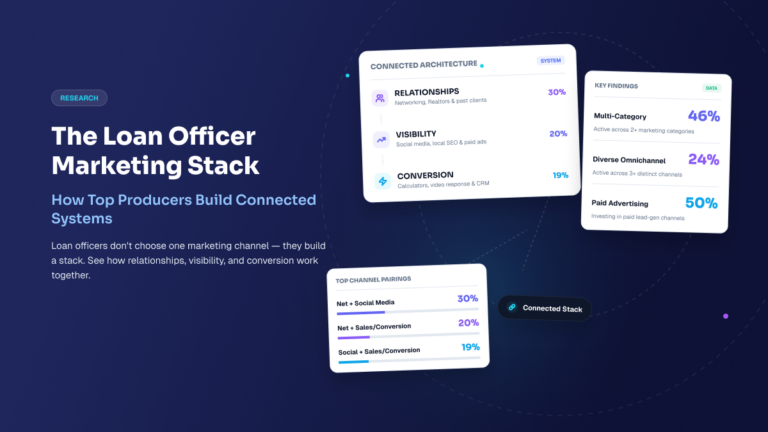

Mortgage marketing used to mean business cards, flyers, email campaigns and networking. Those things can still matter, but the modern loan officer marketing stack has expanded considerably.
Today, borrowers may discover you through Google, visit your website, check your reviews, interact with a mortgage calculator, see your content on social media and return several times before ever reaching out.
That means the most useful mortgage marketing tools aren’t necessarily the ones that help you create more advertisements. They’re the tools that help you build a professional presence, stay visible, engage prospective borrowers and turn that attention into conversations.
You don’t need every marketing tool available. For most loan officers, the goal should be a relatively simple stack that handles the core parts of marketing consistently.
Here are the mortgage marketing tools worth prioritizing.
1. A professional loan officer website
Your website should be the foundation of your online marketing.
It’s where borrowers can learn who you are, understand what you offer, explore loan programs, read reviews, use mortgage tools and decide whether to contact you.
It also gives everything else you do in marketing somewhere to lead.
A social post can link to an educational resource. A real estate agent can send a referral to your site. Someone who receives your name from a past client can Google you and find a professional representation of your business.
A good loan officer website doesn’t need to be complicated, but it should include:
- A clear explanation of who you are and who you help
- Your licensing and required disclosures
- Loan programs or areas of expertise
- Reviews or other relevant social proof
- Useful borrower resources
- Mortgage calculators
- Clear ways to contact you or start an application
- A mobile-friendly experience
You can build a website using a general-purpose website builder, work with a designer or use a mortgage-specific platform.
MLO Studio, created by Morty, combines professional loan officer websites with branding, content, social media tools, mortgage calculators and lead capture in one mortgage-specific marketing platform.
2. Branding tools
Your brand is what makes your marketing recognizable.
That includes the obvious pieces—your logo, colors, fonts and photography—but also how you present yourself, the language you use and the experience someone has across your website and marketing.
Consistency is particularly important for loan officers because prospective borrowers may encounter you in several different places.
Someone might see an Instagram post, receive your name from a real estate agent and then visit your website. Those interactions should feel connected.
Branding tools can help you establish and consistently use:
- Logo and visual identity
- Brand colors
- Typography
- Professional photography
- Marketing templates
- Voice and messaging
The objective isn’t to make every piece of marketing look identical. It’s to make your business recognizable.
For loan officers working within a brokerage or lender, your personal marketing should also follow your company’s brand and advertising requirements.
3. Content creation and AI tools
Creating useful content is one of the easiest marketing activities to neglect when you’re busy working with borrowers.
AI has made that considerably easier.
General AI tools can help brainstorm topics, develop article outlines, draft social posts, create video scripts, rewrite complicated explanations and turn one piece of content into several formats.
Mortgage-specific tools can go further by incorporating your brand and the types of content commonly used by loan officers.
The best source material, however, is still your own expertise.
Think about the questions borrowers ask you repeatedly:
- How much do I need for a down payment?
- When should I get pre-approved?
- What’s included in a monthly mortgage payment?
- What affects affordability?
- What’s the difference between different loan programs?
A single useful explanation can become a website article, email, short video and several social posts.
AI is most valuable when it helps you distribute your expertise more efficiently—not when it replaces it with generic mortgage content.
For a deeper look at this category, see our guide to AI marketing tools for loan officers.
4. Social media marketing tools
Social media can help loan officers remain visible to borrowers, past clients and referral partners between transactions.
The challenge is consistency.
Social media tools can help with:
- Creating branded posts
- Planning a content calendar
- Scheduling content
- Repurposing existing material
- Managing multiple channels
- Tracking engagement
You don’t need to post every day or maintain a presence on every social network.
It’s usually more useful to choose the channels where your audience and professional network are already active and establish a cadence you can realistically maintain.
And content doesn’t always need to be promotional. Mortgage education, answers to borrower questions, short videos, local information and useful homebuying resources can all give people a reason to keep paying attention.
5. Mortgage calculators and borrower tools
Some of the most effective mortgage marketing tools don’t look much like marketing.
A prospective borrower might not be ready to fill out an application, but they may be very interested in estimating a monthly payment or understanding what they can afford.
That’s where interactive tools can be particularly useful.
Common examples include:
- Mortgage payment calculators
- Affordability calculators
- Refinance calculators
- Rent-vs.-buy tools
- Closing-cost or cash-to-close tools
These tools can make your website more useful during the research stage and give prospective borrowers a reason to spend more time engaging with your business.
Current mortgage marketing products increasingly combine calculators with websites and lead capture rather than treating them as standalone widgets.
6. CRM and follow-up tools
Marketing doesn’t end when someone gives you their contact information.
A CRM helps organize prospective borrowers, past clients, referral partners and ongoing relationships so opportunities don’t disappear into an inbox or spreadsheet.
Depending on your business, useful CRM capabilities may include:
- Contact management
- Lead-source tracking
- Email and text follow-up
- Pipeline management
- Referral-partner tracking
- Automated reminders
- Past-client campaigns
- Marketing automation
Mortgage-specific CRMs may also offer workflows designed around the mortgage process or integrations with other mortgage technology.
The right CRM isn’t necessarily the one with the longest feature list. It’s the one you and your team will actually use consistently.
7. Local SEO and Google Business Profile
Search visibility is another important part of the modern mortgage marketing stack.
A prospective borrower may search for a mortgage professional in their area. Someone who receives your name from a friend may Google you before responding. Other borrowers may discover you while researching a particular mortgage question.
Your website provides the foundation, but local search tools help search engines understand your business and location.
For many loan officers, that means paying attention to:
- Google Business Profile
- Consistent business information
- Customer reviews
- Local website content
- Location and service-area information
- Search performance
The objective isn’t simply to rank for broad mortgage terms. It’s to make sure people who are actually looking for you—or for the expertise you provide—can find you.
8. Email marketing tools
Email remains useful because mortgage relationships can last for years.
A borrower who isn’t ready today may be ready several months from now. A past client may eventually refinance, move, purchase an investment property or refer someone they know.
Email tools can help loan officers maintain those relationships at scale.
That might include:
- Educational newsletters
- Homebuying resources
- Follow-up campaigns
- Past-client communication
- Referral-partner updates
- Event invitations
- Relevant market or mortgage information
The key is usefulness.
If every email is asking someone to apply for a mortgage, people will stop paying attention. Good email marketing gives recipients a reason to keep opening your messages.
9. Lead capture and conversion tools
Generating traffic is only useful if interested borrowers have a clear next step.
Lead-capture tools bridge the gap between someone browsing your marketing and someone starting a conversation.
These can include:
- Contact forms
- Consultation requests
- Application links
- Appointment scheduling
- Calculator follow-up
- Landing pages
- Calls to action within educational content
Keep the path simple.
Someone who is ready to speak with you shouldn’t have to search your website to figure out how.
At the same time, not every visitor is ready to apply. Providing lower-commitment ways to engage can help you connect with people earlier in their research process.
10. Analytics and tracking tools
You don’t need to measure everything.
But you should understand enough to know which parts of your marketing are producing attention and which are producing actual opportunities.
Useful measurements can include:
- Website traffic
- Search traffic
- Most-visited pages
- Content engagement
- Lead sources
- Form submissions
- Calculator engagement
- Campaign performance
- Referral sources
- Applications and closed business
The important distinction is between activity and outcomes.
A social post getting thousands of views may be less valuable than an educational page that generates a handful of conversations with prospective borrowers.
Analytics help you determine where your time and marketing budget are actually paying off.
Don’t forget offline mortgage marketing tools
Digital marketing has become more important, but mortgage remains a relationship-driven business.
Traditional materials can still be useful when they support those relationships.
Open-house flyers, business cards, co-branded educational materials, homebuyer guides and event materials can help loan officers connect their physical presence with their digital brand.
The difference today is that these materials don’t have to stand alone.
An open-house flyer can point borrowers to a mortgage calculator. A business card can direct someone to your website. An educational guide can lead to additional resources online.
The strongest marketing systems connect offline relationships with a professional digital presence.
How to choose the right mortgage marketing tools
It’s easy to end up paying for too much software.
Before adding another tool, ask what specific job it needs to perform.
For most loan officers, the core needs are relatively straightforward:
Build your presence.
You need a professional website and recognizable brand.
Get discovered.
You need search visibility, referrals and channels that put your expertise in front of people.
Stay visible.
You need content, social media and email that you can maintain consistently.
Engage borrowers.
You need useful resources and mortgage tools that help people during the research process.
Capture opportunities.
You need clear ways for interested people to contact you.
Follow up.
You need a system for maintaining relationships with leads, partners and past clients.
Understand what’s working.
You need enough analytics to decide where to invest more effort.
The best mortgage marketing stack is the simplest combination of tools that reliably handles those jobs.
An all-in-one approach to mortgage marketing
One challenge with mortgage marketing is that each function has traditionally required a different product.
A loan officer might use one service for a website, another for design, another for social media, separate mortgage calculators and additional tools for lead capture and analytics.
That works, but it also creates more systems to manage.
Mortgage-specific platforms are increasingly bringing several of these functions together.
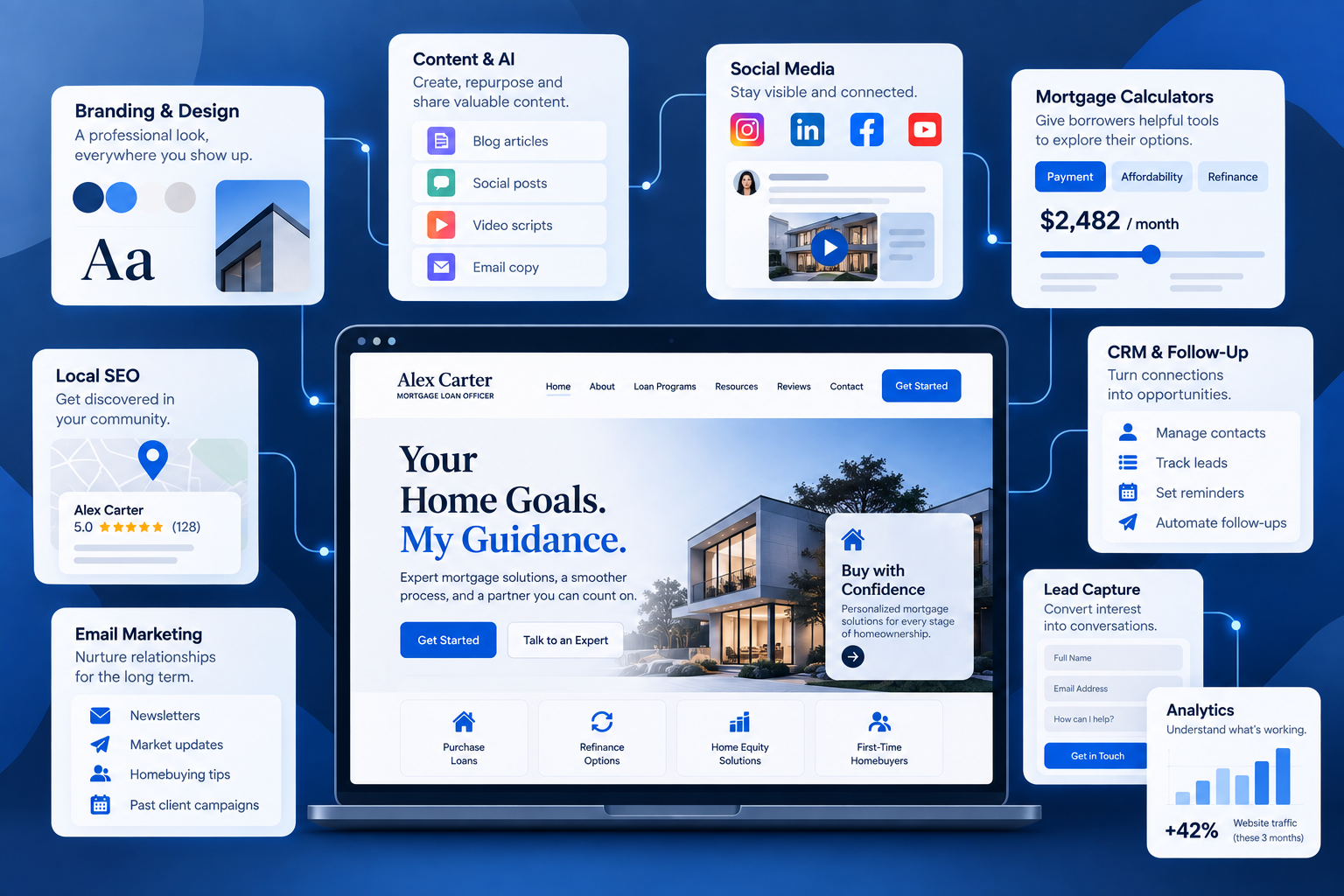
With MLO Studio, loan officers can create a professional website and brand, develop marketing content, manage social media, offer mortgage calculators and capture leads from one platform.
That doesn’t mean every part of your technology stack needs to come from one provider. A CRM, LOS and other operational systems have different jobs.
The goal is simpler: use fewer disconnected marketing tools where combining them genuinely makes your marketing easier to maintain.
Mortgage marketing tools should make consistency easier
The best marketing technology isn’t necessarily the tool with the most features.
It’s the technology that makes the right marketing activities easier to do consistently.
A good website gives your business a professional home. Branding makes your presence recognizable. Content demonstrates expertise. Search and social help people discover it. Mortgage tools give borrowers reasons to engage. Lead capture creates conversations. Follow-up keeps relationships alive.
When those pieces work together, marketing becomes less about constantly launching new campaigns and more about building a presence that compounds over time.